
The functional role of chondrogenic stem/progenitor cells: novel evidence for immunomodulatory properties and regenerative potential after cartilage injury

1 Division for Biochemistry of Joint and Connective Tissue Diseases, Department of Orthopaedics, University of Ulm, Ulm, Germany
2 Department of Orthopaedics and Trauma Surgery, German Armed Forces Hospital Ulm, Ulm, Germany
Abstract
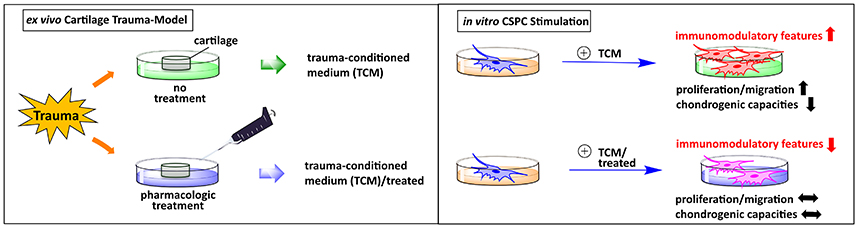
Considering the poor intrinsic healing potential of articular cartilage, resident chondrogenic stem/progenitor cells (CSPCs) have gained attention in recent years. Although, CSPCs are attracted by a cartilage injury, knowledge about the post-traumatic behaviour and functional role of this cell population is fairly basic. The present study, not only elaborated on the regenerative capacities of CSPCs, but also illuminated potential immunomodulatory properties after cartilage trauma.Estimation of the CSPC population size within previously impacted cartilage explants by flow-cytometry revealed an increased percentage of CSPC-marker positive cells as compared to unimpacted tissue. In line with this, proliferation, chemotactic migration andin vitrowound healing activity of isolated CSPCs was similarly enhanced after stimulation with trauma-conditioned (TC) medium. Further, a significant increase in pro- and anti-inflammatory gene expression, as well as IL-6 secretion due to TC-medium-stimulation was measured. In this context, antioxidative or chondroanabolic therapeutic intervention alleviated the post-traumatic response of TC-medium-activated CSPCs and substantially influenced CSPC chondrogenic differentiation in different ways.Overall, this study provided novel insights concerning the functional role of CSPCs after cartilage trauma and the effects of a therapeutic intervention in order to improve regenerative processes and prevent cartilage degeneration following trauma.
Graphical Abstract
Keywords
- Chondrogenic stem/progenitor cells
- cartilage trauma
- post-traumatic osteoarthritis
- damage-associated molecular patterns
- immunomodulation
- chondrogenic differentiation
- fibroblast growth factor 18
- bone morphogenetic protein 7
- insulin-like growth factor 1
- N-acetyl cysteine