

1 Institute for Biomechanics, D-HEST, ETH Zurich, Zurich, Switzerland
2 Department of Orthopaedic Surgery, Fukushima Medical University, School of Medicine, Fukushima, Japan
3 Spine Centre, Schön Clinic Munich Harlaching, Munich, Germany
4 Department of Health Sciences, University of Potsdam, Potsdam, Germany
5 Academic Teaching Hospital and Spine Research Institute, Paracelsus Private Medical University Salzburg, Salzburg, Austria
§ These authors equally contributed to this paper
Abstract
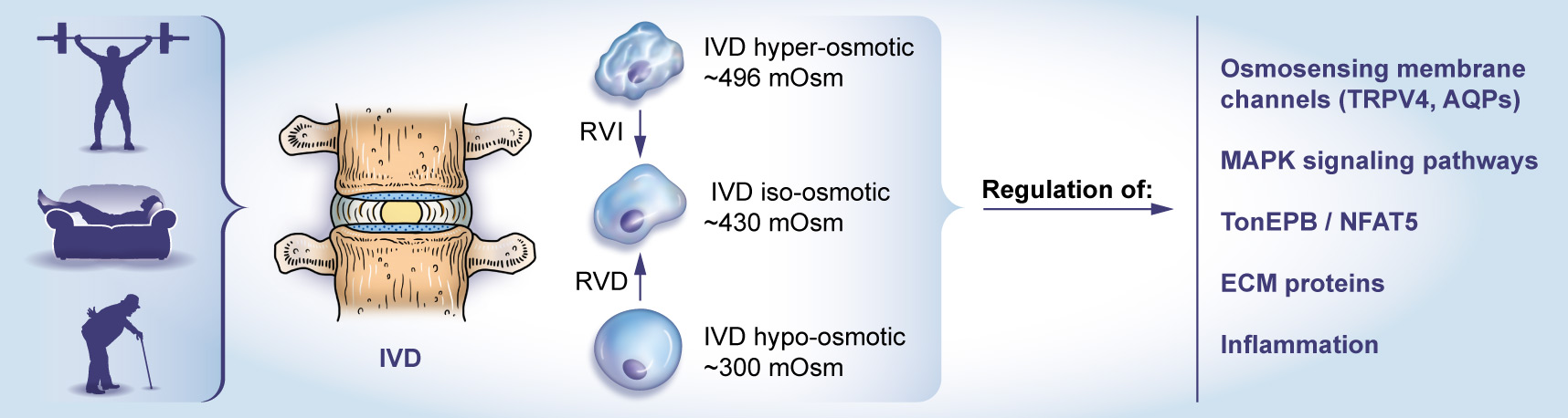
Intervertebral disc (IVD) cells are naturally exposed to high osmolarity and complex mechanical loading, which drive microenvironmental osmotic changes. Age- and degeneration-induced degradation of the IVD’s extracellular matrix causes osmotic imbalance, which, together with an altered function of cellular receptors and signalling pathways, instigates local osmotic stress. Cellular responses to osmotic stress include osmoadaptation and activation of pro-inflammatory pathways. This review summarises the current knowledge on how IVD cells sense local osmotic changes and translate these signals into physiological or pathophysiological responses, with a focus on inflammation. Furthermore, it discusses the expression and function of putative membrane osmosensors (e.g.solute carrier transporters, transient receptor potential channels, aquaporins and acid-sensing ion channels) and osmosignalling mediators [e.g.tonicity response-element-binding protein/nuclear factor of activated T-cells 5 (TonEBP/NFAT5), nuclear factor kappa-light-chain-enhancer of activated B cells (NF-κB)] in healthy and degenerated IVDs. Finally, an overview of the potential therapeutic targets for modifying osmosensing and osmosignalling in degenerated IVDs is provided.
Graphical Abstract
Keywords
- Intervertebral disc degeneration
- degenerative disc disease
- osmolarity
- hyper-osmolarity
- hypo-osmolarity
- osmotic
- inflammatory
- transient receptor potential channel
- aquaporin
- tonicity-responsive enhancer binding protein