
Notochordal cell-derived matrix inhibits MAPK signaling in the degenerative disc environment

1 Department of Clinical Sciences, Faculty of Veterinary Medicine, Utrecht University, Utrecht, The Netherlands
2 NMI TT Pharmaservices, Berlin, Germany
3 NMI Natural and Medical Sciences Institute at the University of Tübingen, Reutlingen, Germany
4 Laboratory for Experimental Orthopedics, Department of Orthopedic Surgery, Maastricht University, Maastricht, The Netherlands
5 Orthopaedic Biomechanics, Department of Biomedical Engineering, Eindhoven University of Technology, Eindhoven, The Netherlands
6 Department of Orthopedics, University Medical Centre Utrecht, Utrecht, The Netherlands
7 Department of Oncology and Metabolism, Medical School, The University of Sheffield, Sheffield, UK
8 Laboratory for Experimental Orthopedics, Department of Orthopedic Surgery, Maastricht University Medical Centre+, Maastricht, The Netherlands
§ These authors equally contributed to this paper
Abstract
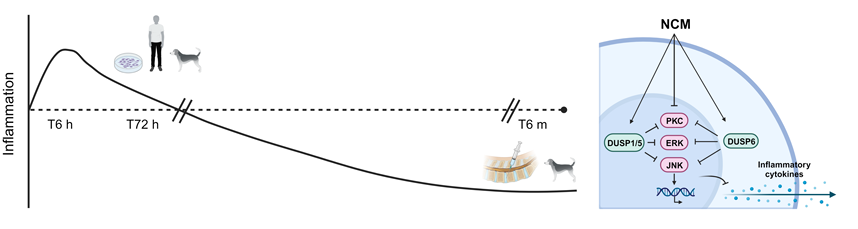
Chronic low back pain is often caused by intervertebral disc (IVD) degeneration. Preceding this degenerative process, the main cellular phenotype in the nucleus pulposus shifts from notochordal cells (NCs) to nucleus pulposus cells (NPCs). In previous studies, porcine NC-derived matrix (NCM), containing NC-secreted factors, induced matrix anabolic effects and inhibited pro-inflammatory mediators in NPCs in vitro and in degenerated canine IVDs in vivo. As the underlying mechanisms remained elusive, this study aimed to explore this with targeted gene expression and proteomic (DigiWest technology) analysis focused on inflammatory signaling pathways.After 6 hours, NCM (10 mg/mL) treatment initially stimulated pro-inflammatory mediators in canine and human NPCs in vitro and increased signaling in a chondrosarcoma derived Nuclear factor-κB reporter cell line. At protein level, NCM mainly induced changes in the Mitogen-activated protein kinase (MAPK) pathway after 72 hours. Expression of inhibitory Dual-specificity phosphatase (DUSP) proteins was increased in NCM-treated NPCs, whereas the expression of the three main pillars of the MAPK pathway (extracellular signal-regulated kinase (ERK)/cJun N-terminal kinase (JNK)/protein kinase C (PKC)) was inhibited. In follow-up validation, in vivo degenerated canine IVDs treated with an intradiscal NCM injection demonstrated increased DUSP5 and healthy nucleus pulposus marker (cytokeratin 19, Paired box 1 (PAX1), Forkhead Box F1 (FOXF1)) immunopositivity after 6 months of treatment.Altogether, NCM initially stimulated pro-inflammatory mediators in vitro, but thereafter exerts its prolonged effects by inhibiting the MAPK pathway. These findings provide insights in the underlying mechanisms involved in the instructive capacity of this naturally-derived biomaterial with the potential to serve as a cell-free NC-based therapy to treat intervertebral disc degeneration.
Graphical Abstract
Keywords
- Intervertebral disc degeneration
- inflammation
- notochordal cells
- extracellular matrix
- mitogen-activated protein kinase pathway
- dual specificity phosphatase