

1 State Key Laboratory of Oral Disease & National Clinical Research Center for Oral Diseases, West China Hospital of Stomatology, Sichuan University, 610041 Chengdu, Sichuan, China
2 National Engineering Laboratory for Oral Regenerative Medicine, West China Hospital of Stomatology, Sichuan University, 610041 Chengdu, Sichuan, China
3 Department of Pediatric Dentistry, West China Hospital of Stomatology, Sichuan University, 610041 Chengdu, Sichuan, China
4 Frontier Innovation Center for Dental Medicine Plus, West China Hospital of Stomatology, Sichuan University, 610041 Chengdu, Sichuan, China
5 Yunnan Key Laboratory of Stomatology, The Affiliated Hospital of Stomatology, School of Stomatology, Kunming Medical University, 650500 Kunming, Yunnan, China
Abstract
Fracture healing is a complex event that involves the coordination of various different processes, including intramembranous and endochondral bone formation. When facing fracture nonunion or delayed union, few organizational engineering structures can achieve the desired results. The main reason for this is that they cannot recapitulate the cellular morphology, biology, and mechanical functions of natural tissues. Ten years ago, the term Development Engineering was coined to refer to the use of developmental processes as a blueprint for designing and developing engineered live implants. Different sources of cells have been used as seed cells in developmental engineering. Among them, hypertrophic chondrocytes have attracted worldwide attention. Hypertrophic chondrocytes are the terminal state of growth plate chondrocytes, leading to degenerative maturation. Hypertrophic chondrocytes mediate crosstalk by regulating cell-matrix degradation, vascularization, osteoclast recruitment, and osteoblast differentiation. Furthermore, hypertrophic chondrocytes can transdifferentiate into osteoprogenitors and mature osteoblasts, and directly promote woven bone formation. In summary, elucidating the role of hypertrophic chondrocytes will contribute to understand of the physiological mechanism of fracture healing, research and development of novel therapeutic modes of developmental engineering, and further promotion of fracture healing.
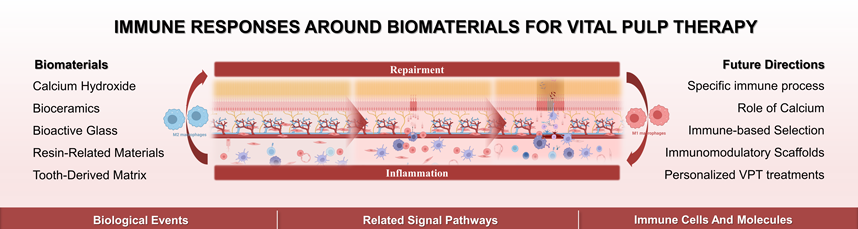
Graphical Abstract
Keywords
- Biomaterial
- vital pulp therapy (VPT)
- immune response
- pulp regeneration
- pulp capping