
Investigation of the safety and therapeutic efficacy of axonal dieback compounds in a rat model of disc-associated low back pain

1 Department of Biological Systems Engineering, University of Nebraska-Lincoln, Lincoln, NE 68508, USA
2 J. Crayton Pruitt Family Department of Biomedical Engineering, Biomedical Sciences Building, University of Florida, Gainesville, FL 32603, USA
3 Arizona State University, School of Biological and Health Systems Engineering, Tempe, AZ 85287-9709, USA
Abstract
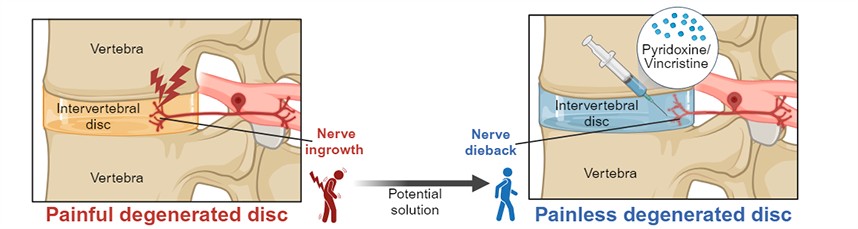
Introduction:Low back pain (LBP) is a global health issue and the primary cause of disability. The majority of LBP cases are associated with intervertebral disc degeneration and aberrant nerve growth into the discs. The correlation between presence of nerve fibers in degenerated discs and disc-associated LBP suggests that fiber removal could reverse the pain. Due to the neurodegenerative effects of pyridoxine and vincristine, we hypothesized that these compounds can be repurposed to induce local axonal dieback within the disc and alleviate pain.Methods:Two studies were conducted to test the safety and efficacy of these compounds. A safety study involved injecting pyridoxine and vincristine directly into rat L5–L6 lumbar discs and revealed no adverse effects on the animals’ general health. Using a female rat model of disc-associated LBP, the efficacy of pyridoxine and vincristine was assessed through pain-like behavior assays.Results:Disc scrape injury induced disc degeneration, axial hypersensitivity, and aberrant nerve sprouting, but did not significantly impact open field test behaviors and gait. While both compounds partially alleviated axial hypersensitivity, only pyridoxine reduced nerve fiber staining in the disc. The amount of nerve fibers in the disc were correlated significantly with the degree of axial hypersensitivity. Gene expression analysis of dorsal root ganglia indicated upregulation of nociceptive ion channels and proinflammatory mediators after disc injury, and only vincristine reduced neural sensitization and inflammation.Conclusions:The findings suggest that pyridoxine and vincristine are safe for intradiscal use and may hold potential as treatments for disc-associated LBP, offering a promising avenue for treatment.
Graphical Abstract
Keywords
- Low back pain
- intervertebral disc degeneration
- nerve
- pain
- denervation
- axonal dieback
- dorsal root ganglia