
Sex specific knee joint soft tissue mineralization with fibrillin-1 mutation in male tight skin mice

1 Musculoskeletal and Ageing Sciences Department, Institute of Lifecourse and Medical Sciences, University of Liverpool, L78TX Liverpool, UK
2 Faculty of Health, Social Care and Medicine, Edge Hill University, L394QP Ormskirk, UK
3 Department of Occupational and Environmental Health, School of Public Health, Xi’an Jiaotong University Health Science Center, 710061 Xi’an, Shaanxi, China
4 Deptartment of Histology and Embryology, Faculty of Medicine, İstanbul Health and Technology University, 34275 İstanbul, Turkey
5 Department of Inflammation and Rare Diseases, UCL Centre for Rheumatology, University College London, NW32PF London, UK
Abstract
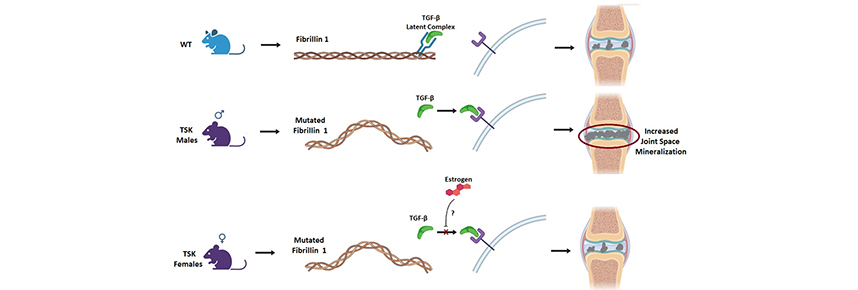
Background:Articular soft tissue mineralization and ossification are clear pathological signs of osteoarthritis (OA) joints. However their molecular and cellular aetiologies remain largely unknown. Transforming growth factor beta (TGF-β) family members are known contributors to both pathological ossification and osteoarthritis development. In this study, we used a fibrillin-1 (Fbn1) mutant mouse, the tight skin (TSK) mouse, to define the detrimental effects of abnormal Fbn1 in TSK mice and known high TGF-β activity in joint pathology such as articular soft tissue mineralization and ossification.Methods:Knee joints of male and female TSK and wild-type (WT) littermates were analysed by micro-computed tomography (micro-CT) imaging and histology for articular soft tissue pathologies, as well as OA severity. Both aged (10, 26, 35 and 52 weeks) and followingin vivonon-invasive repetitive joint overloading were used.Results:We find that male TSK mice develop spontaneous soft tissue ossification from 26 weeks of age, followed by increased osteoarthritis at 1 year-old. In addition, knee joint overloading induced ligament and meniscal mineralisation and ossification in both WT and TSK male mice, but were significantly more severe in TSK knees, including ossification of the patella ligament and synovial lining. In contrast, female TSK knees did not develop more severe soft tissue mineralisation compared to littermate WT mice in neither aged nor overloaded knees.Conclusions:We conclude that Fbn1 mutation, and possibly overactive TGF-β activity in TSK mice, induce articular soft tissue ossification and osteoarthritis in a sex-specific manner. Further studies are needed to confirm the specific signalling involved and the relative protection from female mice from such pathologies.
Graphical Abstract
Keywords
- Ossification
- articular pathology
- mouse mutant
- fibrillin-1
- osteoarthritis
- mechanical loading