
Hydrogel-exosome systems in the treatment of refractory diabetic ulcers: mechanisms, progress, and prospects
 , Z. Q. Liu 2,*
1 Jishou University Zhuzhou Clinical College, Medical College, Jishou University, 412000 Zhuzhou, Hunan, China
2 Trauma Center Department Three, Zhuzhou Hospital Affiliated to Xiangya School of Medicine, Central South University, 412000 Zhuzhou, Hunan, China
3 Department of Medicine, Lausanne University Hospital (CHUV) and University of Lausanne, 1011 Lausanne, Switzerland
4 Faculty of Biology and Medicine, University of Lausanne, 1011 Lausanne, Switzerland
§These authors contributed equally.
Abstract
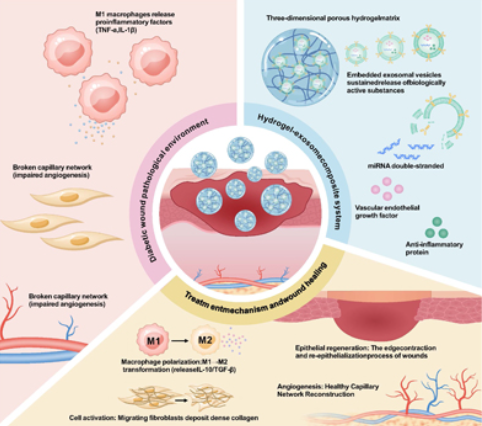
Diabetic wounds pose significant clinical challenges due to their delayed healing, chronic inflammation, poor angiogenesis, and impaired cell migration. Exosomes, which are rich in proteins, RNAs, and other bioactive molecules, have properties that promote antiinflammatory and tissue repair processes. On the other hand, hydrogels provide a moist environment that facilitates controlled drug release, thereby enhancing wound healing. This review explores the potential of hydrogel-exosome composites to overcome the challenges of treating diabetic wounds by regulating macrophage polarization, reducing inflammation, and promoting angiogenesis and fibroblast migration, thus accelerating wound repair.
Graphical Abstract
Keywords
- Exosome
- hydrogel
- diabetic wound
- healing