
Yishenjuanbi pill-containing serum attenuates osteoclastogenesis in ovariectomized rats with collagen-induced arthritis by enhancing EphrinB2 signalling
 , H.Y. Zhao 1,*
1 Experimental Research Center, China Academy of Chinese Medical Sciences, 100010 Beijing, China
2 Department of Joints and Soft Tissue Injury, Shenzhen Traditional Chinese Medicine Hospital, The Fourth Clinical Medical College of Guangzhou University of Chinese Medicine, 518000 Shenzhen, Guangdong, China
3 Department of Cardiovascular Sciences and Center for Metabolic Disease Research, Lewis Katz School of Medicine, USA Temple University, Philadelphia, PA 19140, USA
4 Health Science Center, Peking University, 100091 Beijing, China
5 China College of Exercise and Health, Jilin Sport University, 130022 Changchun, Jilin, China
§These authors contributed equally.
Abstract
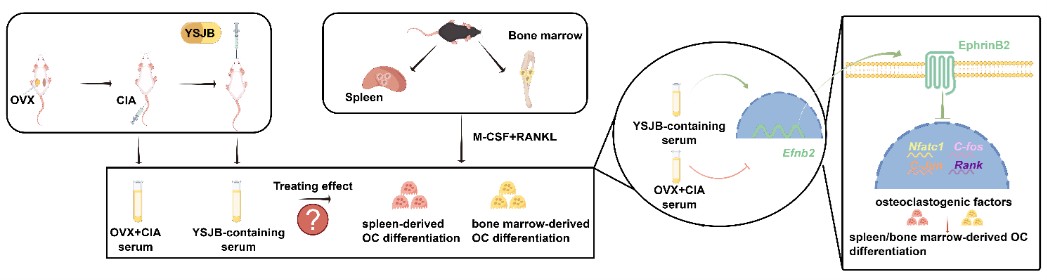
Background: Rheumatoid arthritis (RA) disproportionately affects postmenopausal women and manifests as accelerated cartilage and bone erosion driven by hyperactive osteoclasts (OCs). Oestrogen deficiency exacerbates OC activity, while the Eph receptor interacting protein B2 (EphrinB2)/Eph receptor B4 (EphB4) signalling pathway acts as a critical negative regulator of OC differentiation by suppressing the cellular oncogene c-Fos (c-Fos)/nuclear factor of activated T cells cytoplasmic 1 (NFATc1) transcription cascade. The traditional Chinese medicine (TCM) Yishenjuanbi pill (YSJB) enhances EphrinB2-mediated bone protection and demonstrates superior therapeutic efficacy in an ovariectomized collagen-induced arthritis (OVX + CIA) rat model compared with its effects in CIA rats, although its effects on osteoclasts (OCs) remain incompletely characterized. Methods: Bone marrow-derived macrophages (BMMs) and splenic monocytes were employed to elucidate the EphrinB2-dependent mechanisms through which YSJB inhibits OC differentiation. Rat serum from the Control, OVX, CIA, OVX + CIA, OVX + CIA + oestradiol valerate (EV), and OVX + CIA + YSJB groups was prepared and added during osteoclast induction. Quantitative reverse transcription PCR (RT-qPCR), tartrate-resistant acid phosphatase (TRAP) staining, and bone resorption assays were performed on both cell types. Results: YSJB reversed the ovariectomy + CIA-induced upregulation of the osteoclastogenic factors c-Fos, transcription factor c-Jun (c-Jun), Nfatc1, and receptor activator of nuclear factor-κb (Rank) while restoring encoding EphrinB2 (Efnb2) expression (n = 3). Crucially, Efnb2 knockdown abolished the protective effects of YSJB, restoring pathological OC activity and increasing gene expression levels (n = 3). Conclusions: Our findings suggest that by upregulating EphrinB2, YSJB serum inhibits osteoclastogenesis in both BMMs and splenic monocytes.
Graphical Abstract
Keywords
- Collagen-induced arthritis
- osteoclasts
- Yishenjuanbi pill
- EphrinB2 signalling pathway