
Exosomes in tissue engineering and cell-free therapy: A comprehensive review
 , F.F. Yang 1, J.B. Liu 1, M. Li 2, F. Mao 3, D.K.W. Ocansey 4, Y.B. Wu 5,*
1 Center of Medical Genetics, Yancheng Maternal and Child Health Care Hospital Affiliated to Yangzhou University, 224000 Yancheng, Jiangsu, China
2 Department of Prenatal Diagnosis, Yancheng Maternal and Child Health Care Hospital Affiliated to Yangzhou University, 224000 Yancheng, Jiangsu, China
3 Key Laboratory of Medical Science and Laboratory Medicine of Jiangsu Province, School of Medicine, Jiangsu University, 212013 Zhenjiang, Jiangsu, China
4 Department of Medical Laboratory Science, School of Allied Health Sciences, College of Health and Allied Sciences, University of Cape Coast, CC0959347 Cape Coast, Ghana
5 Department of Medicine Laboratory, Northern Jiangsu People’s Hospital, 225001 Yangzhou, Jiangsu, China
Abstract
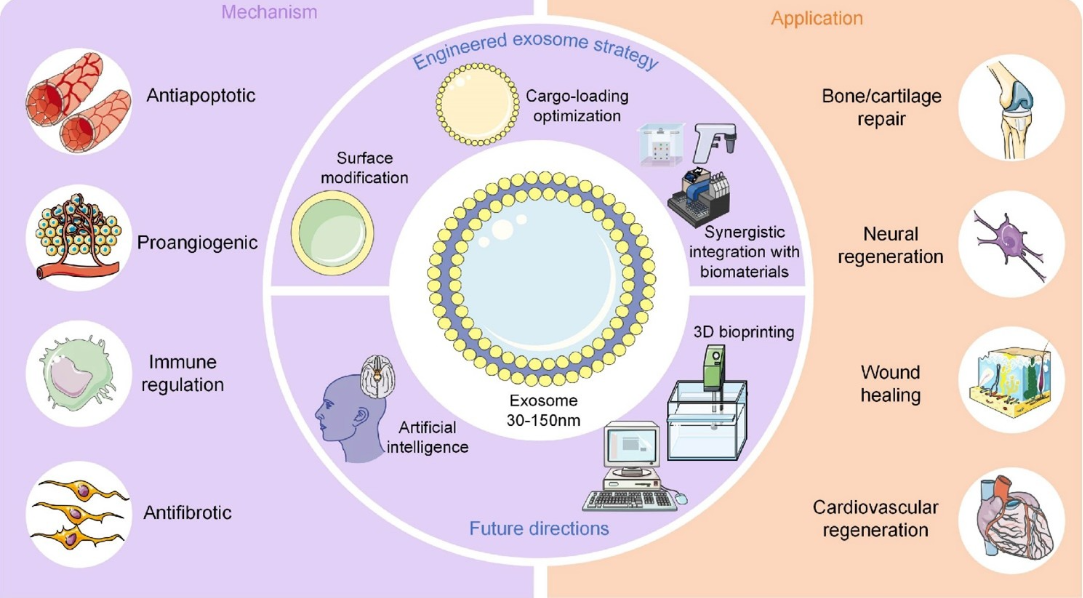
As a critical subclass of extracellular vesicles, exosomes have emerged as a research focus in tissue regeneration and precision therapy because of their unique molecular delivery and intercellular communication capabilities. This article systematically reviews the biogenesis, isolation, and characterization of exosomes and their role in advancing tissue engineering applications. Their multifaceted regulatory roles in bone/cartilage repair, neural regeneration, wound healing, and cardiovascular regeneration, including antiapoptotic, proangiogenic, immunomodulatory, and antifibrotic mechanisms, are highlighted. The innovations of this work lie in (1) the comprehensive analysis of engineered exosome strategies—such as surface modification, cargo-loading optimization, and synergistic integration with biomaterials—to overcome the limitations of traditional delivery systems; (2) the proposal of the dual regulatory potential of exosomes in cancer immunotherapy and autoimmune diseases, offering novel insights for clinical translation; and (3) the envisioning of future directions by integrating artificial intelligence (AI) and three-dimensional (3D) bioprinting to advance scalable production and precision design of exosome-based therapies. This article further addresses current challenges (e.g., heterogeneity, standardization, and safety) and emphasizes interdisciplinary collaboration to bridge the gap between fundamental research and clinical translation. This review provides a theoretical framework and technical foresight for advancing regenerative medicine and precision therapeutics.
Graphical Abstract
Keywords
- Exosomes
- tissue regeneration
- cell-free therapy