
 , Daixu Wei 1,*
1 Zigong Academy of Medical Sciences, Zigong First People’s Hospital, 643000 Zigong, Sichuan, China
2 Department of Orthopedics, Zigong First People’s Hospital, 643000 Zigong, Sichuan, China
3 Department of Nuclear Medicine, Zigong First People’s Hospital, 643000 Zigong, Sichuan, China
§These authors contributed equally.
Abstract
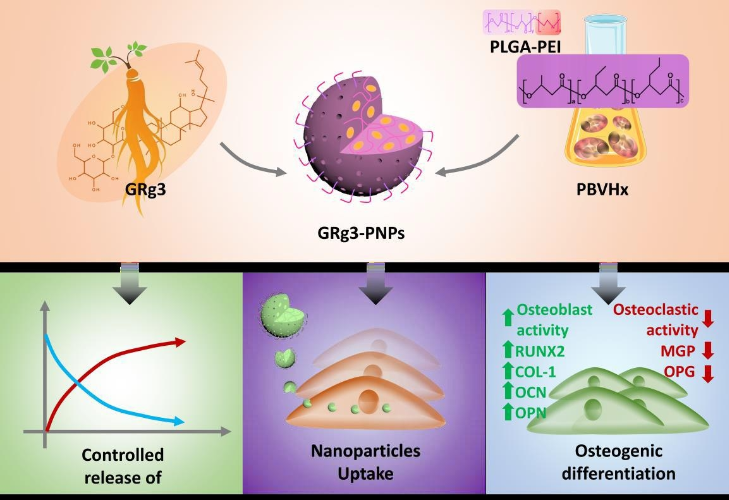
Background: Osteoporosis, a metabolic disorder with reduced bone density and high fracture risk, can be alleviated by ginsenoside Rg3 (GRg3), which promotes human bone marrow-derived mesenchymal stem cell (hBMSC) osteogenic differentiation via multiple pathways. However, GRg3’s clinical use is limited by hydrophobicity, short half-life, and degradation susceptibility. Methods: This study developed a novel nanocarrier using biodegradable poly (3-hydroxybutyrate-co-3-hydroxyvalerate-co-3-hydroxyhexanoate) (PBVHx) (the latest terpolymer in polyhydroxyalkanoates) doped with a small amount of poly (lactic-co-glycolic acid)-polyethylenimine conjugate (PLGA-PEI) to encapsulate GRg3 (GRg3-PBVHx-based nanoparticles (PNPs)). GRg3-PNPs (1%, 5%, 10% loadings) were spherical, with sizes 105–160 nm (increasing with GRg3) and stable dispersibility. Results: Encapsulation efficiency was ∼ 89% for 1% and 5% groups, but 38.21% for 10% due to leakage. In vitro, GRg3 released sustainably over 20 days, synchronized with degradation. Cellular experiments showed efficient uptake by hBMSCs. 5% and 10% GRg3-PNPs enhanced cell viability; the 5% group exhibited the strongest osteogenic efficacy, with increased alkaline phosphatase (ALP) activity, calcium deposition, upregulated pro-osteogenic markers (collagen type I (COL-1), osteocalcin (OCN), osteopontin (OPN), runt-related transcription factor 2 (RUNX2)), and downregulated inhibitory markers (matrix Gla protein (MGP), osteoprotegerin (OPG)). Conclusions: This nanosystem, with 5% GRg3-PNPs as the optimal formulation, efficiently delivers poorly soluble GRg3 and shows promise for traditional Chinese medicine (TCM)-based osteoporosis treatment and bone regeneration.
Graphical Abstract
Keywords
- Polyhydroxyalkanoates
- ginsenoside
- osteoporosis
- nanocarriers
- stem cells