
 , Yu Mori 2, Ryo Hamai 1, Ryuichi Kanabuchi 2, Toshimi Aizawa 2
1 Division of Biomaterials Science and Engineering (Division of Craniofacial Function Engineering), Tohoku University Graduate School of Dentistry, 980-8575 Sendai, Japan
2 Department of Orthopaedic Surgery, Tohoku University Graduate School of Medicine, 980-8574 Sendai, Japan
Abstract
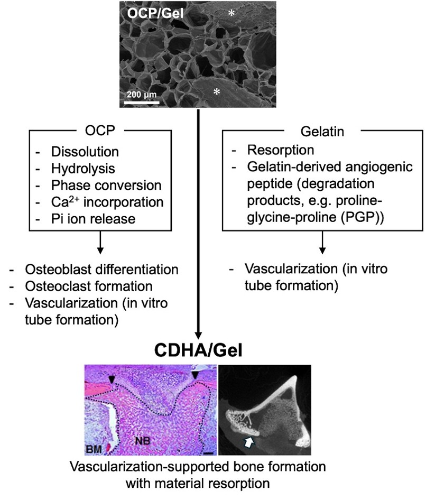
Bone grafting is a widely utilized treatment for bone defects and augmentation of bone fusion, and the development of bone substitute materials with superior osteogenic potential is of significant interest as an alternative to autogenous bone grafting. Octacalcium phosphate (OCP) has been investigated as a bone substitute material due to its capacity to promote replacement with new bone more effectively than hydroxyapatite (HA) and β-tricalcium phosphate (β-TCP) in preclinical studies. The solubilities of OCP and β-TCP are higher than that of HA under the physiological conditions, according to the thermodynamic stability of these crystal structures. However, OCP promotes osteoblastic differentiation and osteoclast formation compared to β-TCP and HA, which is associated with the difference in the dissolution behaviors of these calcium phosphates. OCP has been combined with natural polymers such as collagen and gelatin to enhance its handling properties and clinical applicability. Among these composites, OCP/gelatin (OCP/Gel) has demonstrated superior osteoconductivity and biodegradability compared to β-TCP in the long bone defect model. Therefore, OCP/Gel composites should provide an optimal balance between new bone formation and material resorption, addressing a critical limitation of β-TCP in clinical applications. This review article focuses on the intrinsic biodegradable property of OCP and summarizes the development and preclinical findings of OCP and OCP/Gel composites, and exploring the potential for orthopedic application.
Graphical Abstract
Keywords
- Octacalcium phosphate
- gelatin
- β-tricalcium phosphate
- biodegradation
- bone regeneration