
Inhalable bionic nanoparticle vaccine mimicking pulmonary surfactant enhances anti-tuberculosis immunity
 , Bin Li 2,3,*
1 Guangdong Provincial Key Laboratory of Immune Regulation and Immunotherapy, School of Laboratory Medicine and Biotechnology, Southern Medical University, 510000 Guangzhou, Guangdong, China
2 School of Inspection, Ningxia Medical University, 750004 Yinchuan, Ningxia, China
3 School of Basic Medical Sciences, Ningxia Medical University, 750004 Yinchuan, Ningxia, China
4 Department of Microbiology, School of Public Health, Southern Medical University (Guangdong Provincial Key Laboratory of Tropical Disease Research), 510515 Guangzhou, Guangdong, China
5 Institute for Engineering Medicine, Kunming Medical University, 650500 Kunming, Yunnan, China
6 Institute for Biomedical Sciences, Georgia State University, Atlanta, GA 30303, USA
7 Department of Critical Care Medicine & Department of Emergency, Renmin Hospital of Wuhan University, 430060 Wuhan, Hubei, China
§These authors contributed equally.
Abstract
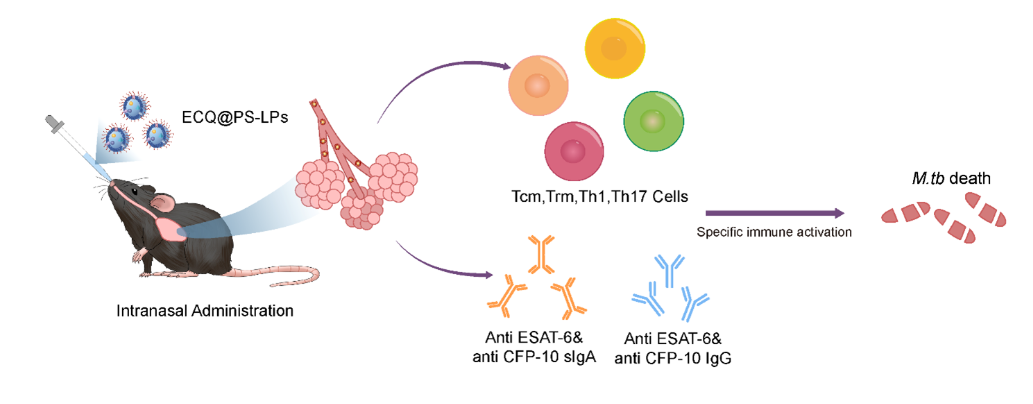
Background: Tuberculosis (TB), an infectious disease caused by Mycobacterium tuberculosis (M.tb), remains a formidable global public health threat. The currently available Bacillus Calmette-Guérin (BCG) vaccine, while effective in children, provides inadequate protection for adults, highlighting an urgent need for novel vaccine development. Methods: This study constructed an inhalable biomimetic nanoparticle vaccine, designated ECQ@PS-LPs. The vaccine utilizes liposomes that mimic natural pulmonary surfactant as a carrier to co-encapsulate two key TB antigens, ESAT-6 and CFP-10, along with the immunoadjuvant QS-21. Following intranasal administration in mice, immune responses and protective efficacy were evaluated. Using one-way ANOVA with post-hoc testing, statistical significance was defined as *p < 0.05, **p < 0.01 and ***p < 0.001. Results: The ECQ@PS-LPs vaccine effectively breached the alveolar surfactant barrier, significantly enhancing uptake by antigen-presenting cells. This triggered a robust multidimensional immune response, including potent cellular immunity (characterized by Th1 and Th17 responses), systemic humoral immunity (indicated by IgG production), and strong mucosal immunity (evidenced by sIgA). Furthermore, the vaccine induced durable immune memory, marked by the generation of tissue-resident memory T cells (TRM) and central memory T cells (TCM). In a M.tb challenge model, ECQ@PS-LPs conferred a level of protection comparable to the BCG vaccine and elicited a superior mucosal immune response. The vaccine formulation also demonstrated a simple preparation process and favorable biological safety profile. Conclusions: ECQ@PS-LPs represents a promising inhalable candidate vaccine for TB. It effectively induces comprehensive and persistent immune protection, particularly at the mucosal site, offering a novel and strategic direction for preventing TB in adults.
Graphical Abstract
Keywords
- Tuberculosis
- biomimetic nanovaccine
- alveolar surfactant-mimicking
- cellular immunity