Mitochondrial transfer from adipose-derived stem cells improves the chondrogenic phenotype in senescent chondrocytes by ameliorating mitochondrial dysfunction
 , Yaohui Huang 4,§, Peilin Shao 5, Linghua Chang 1,2, Chengchang Lu 1,2,6,7,8, Chunghwan Chen 1,2,6,7,8,9,10,11, Yinchih Fu 1,2,7,8,12, Meiling Ho 1,2, Jeken Chang 1,2,7, Shuncheng Wu 1,2,5,*
1 Regenerative Medicine and Cell Therapy Research Center, Kaohsiung Medical University, 807378 Kaohsiung, Taiwan
2 Orthopaedic Research Center, College of Medicine, Kaohsiung Medical University, 807378 Kaohsiung, Taiwan
3 Department of Food Science, Yuanpei University of Medical Technology, 300102 Hsinchu, Taiwan
4 Department of General Medicine, Kaohsiung Medical University Chung-Ho Memorial Hospital, Kaohsiung Medical University, 807378 Kaohsiung, Taiwan
5 Department of Nursing, Asia University, 413305 Taichung, Taiwan
6 Department of Orthopedics, Kaohsiung Municipal Siaogang Hospital, Kaohsiung Medical University, 812 Kaohsiung, Taiwan
7 Department of Orthopedics, Kaohsiung Medical University Hospital, Kaohsiung Medical University, 807378 Kaohsiung, Taiwan
8 Ph.D. Program in Biomedical Engineering, College of Medicine, Kaohsiung Medical University, 807378 Kaohsiung, Taiwan
9 School of Medicine, College of Medicine, Kaohsiung Medical University, 807378 Kaohsiung, Taiwan
10 Institute of Medical Science and Technology, National Sun Yat-sen University, 804 Kaohsiung, Taiwan
11 Graduate Institute of Materials Engineering, College of Engineering, National Pingtung University of Science and Technology, 912301 Pingtung, Taiwan
12 Department of Orthopedics, Kaohsiung Show-Chwan Memorial Hospital, 821011 Kaohsiung, Taiwan
§These authors contributed equally.
Abstract
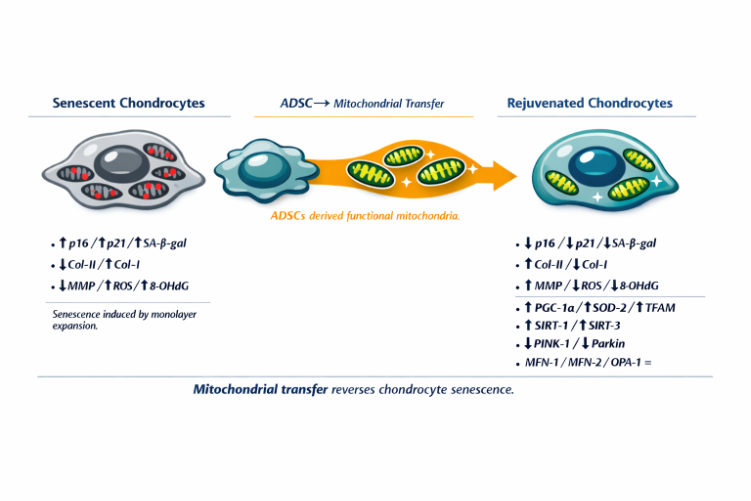
Background: Obtaining sufficient chondrocytes by monolayer expansion in vitro is used for articular cartilage tissue engineering. However, chondrocytes lose their chondrogenic phenotype after monolayer expansion via mitochondrial dysfunction-induced senescence. Adipose-derived stem cell mitochondrial transfer (ADSC-MT) improves senescent cell function. We hypothesise that ADSC-MT improves the chondrogenic phenotype of senescent chondrocytes. Methods: After monolayer expansion in vitro, chondrocytes were subjected to ADSC-MT. Cell senescence was evaluated via analysis of p16 and p21 expression and senescence-associated β-galactosidase (SA-β-gal) staining. The chondrogenic phenotype was evaluated by measuring collagen type II (Col-II) and collagen type I (Col-I) levels. Oxidative stress was assessed by determining the mitochondrial superoxide and 8-hydroxydeoxyguanosine (8-OHdG) levels. Mitochondrial dysfunction was assessed by determining the mitochondrial membrane potential (MMP) and PGC-1α levels. Finally, SOD-2, SIRT-1, SIRT-3, TFAM, MFN-1, MFN-2, OPA-1, PINK-1 and Parkin levels were used to assess mitochondrial quality control (MQC). Results: ADSC-MT-recipient chondrocytes exhibited alleviated senescence with decreased p16 and p21 expression and SA-β-gal staining. The increased Col-II and decreased Col-I expression indicated that the chondrogenic phenotype of the chondrocytes was restored. Decreased mitochondrial superoxide and 8-OHdG levels indicated alleviated oxidative stress. The increased MMP indicated alleviation of mitochondrial dysfunction. For MQC, SOD‑2, PGC‑1α, TFAM, SIRT-1, and SIRT-3 were upregulated, indicating that antioxidant defences and mitochondrial biogenesis in MQC were increased in ADSC‑MT–recipient chondrocytes. PINK‑1 and Parkin were downregulated, suggesting that damaged mitochondria were reduced through mitophagy. In contrast, MFN‑1, MFN‑2, and OPA‑1 were not changed, indicating that mitochondrial dynamics were not affected. Conclusions: ADSC-MT improves the chondrogenic phenotype of senescent chondrocytes by ameliorating mitochondrial dysfunction.
Graphical Abstract