
Impact of TGF-β family-related growth factors on chondrogenic differentiation of adipose-derived stem cells isolated from lipoaspirates and infrapatellar fat pads of osteoarthritic patients

1 Department of Health Sciences, University of Jaén, Jaén, Spain
2 Biopathology and Regenerative Medicine Institute (IBIMER), Centre for Biomedical Research, University of Granada, Granada, Spain
3 Department of Human Anatomy and Embryology, Faculty of Medicine and Excellence Research Unit “Modelling Nature” (MNat), University of Granada, Spain
4 Biosanitary Research Institute of Granada (ibs.GRANADA), University Hospitals of Granada-University of Granada, Granada, Spain
5 Drug Discovery Collaboratory, Qualcomm Institute, University of California, La Jolla, California, USA
6 Department of Orthopaedic Surgery and Traumatology, Virgen de la Victoria University Hospital, Málaga, Spain
7 Institute of Biomedical Research in Malaga (IBIMA), Málaga, Spain
8 Department of Histology, Faculty of Medicine, University of Granada, Granada, Spain
§ These authors equally contributed to this paper
Abstract
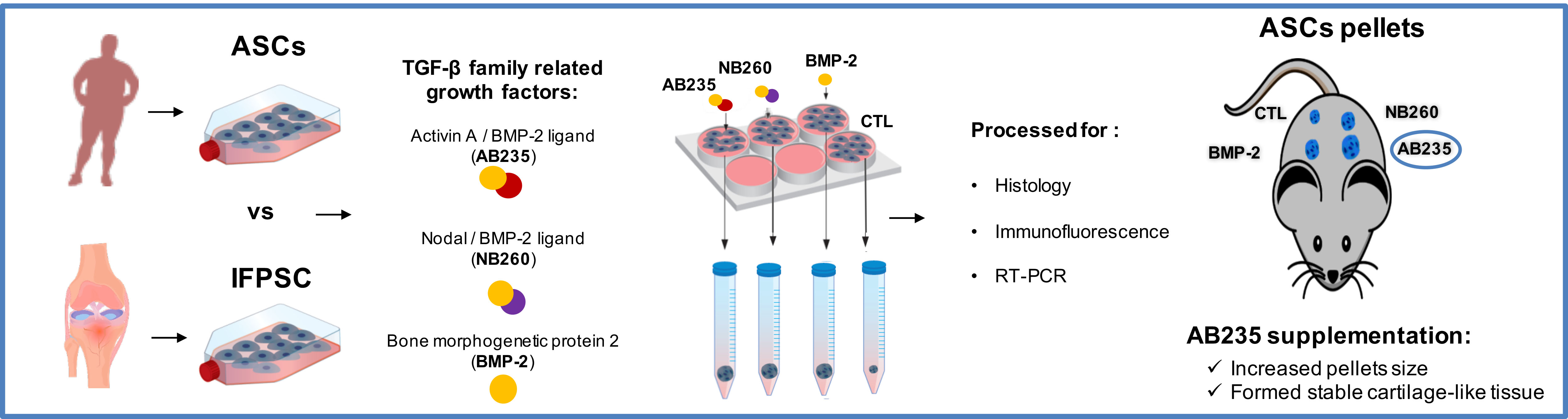
The success of cell-based approaches for the treatment of cartilage defects requires an optimal autologous cell source with chondrogenic differentiation ability that maintains its differentiated properties and stability following implantation. The objective of this study was to compare the chondrogenic capacity of mesenchymal stem cells (MSCs) isolated from lipoaspirates (ASCs) and the infrapatellar fat pad (IFPSCs) of osteoarthritic patients and treated with transforming growth factor (TGF)-β family-related growth factors. Cells were cultured for 6 weeks in a 3D pellet culture system with the chimeric activin A/bone morphogenic protein (BMP)-2 ligand (AB235), the chimeric nodal/BMP-2 ligand (NB260) or BMP-2. To investigate the stability of the new cartilage, ASCs-treated pellets were transplanted subcutaneously into severe combined immunodeficiency (SCID) mice. Histological and immunohistochemical assessment confirmed that the growth factors induced cartilage differentiation in both isolated cell types. However, reverse transcription-quantitative PCR results showed that ASCs presented a higher chondrogenic potential than IFPSCs. In vivo results revealed that AB235-treated ASCs pellets were larger in size and could form stable cartilage-like tissue as compared to NB260-treated pellets, while BMP-2-treated pellets underwent calcification. The chondrogenic induction of ASCs by AB235 treatment was mediated by SMAD2/3 activation, as proved by immunofluorescence analysis. The results of this study indicated that the combination of ASCs and AB235 might lead to a cell-based cartilage regeneration treatment.
Graphical Abstract
Keywords
- Adipose stem cells
- chondrogenic differentiation
- osteoarthritis
- transforming growth factor-β family-related growth factors