
Long term outcomes of biomaterial-mediated repair of focal cartilage defects in a large animal model

1 Acute Cartilage Injury Consortium, AO Exploratory Research Collaborative Research Program, Davos Platz, Switzerland
2 Translational Musculoskeletal Research Center, CMC VA Medical Center, Philadelphia, PA, USA
3 Department of Orthopaedic Surgery, University of Pennsylvania, Philadelphia, PA, USA
4 AO Research Institute Davos, Davos Platz, Switzerland
5 Centre of Experimental Orthopaedics, Saarland University Medical Centre, Homburg/Saar, Germany
6 School of Pharmacy, University of Nottingham, UK
7 Department of Chemical and Environmental Engineering, University of Nottingham, UK
8 Tissue Engineering Laboratory, Bioengineering Department, IQS School of Engineering, Universitat Ramon Llull, Barcelona, Spain
9 Department of Orthopaedics and Rehabilitation, Oregon Health & Science University, Portland, OR, USA
10 Cytex Therapeutics, Durham, NC, USA
11 Washington University and Shriners Hospitals for Children, St. Louis, MO, USA
§ These authors equally contributed to this paper
Abstract
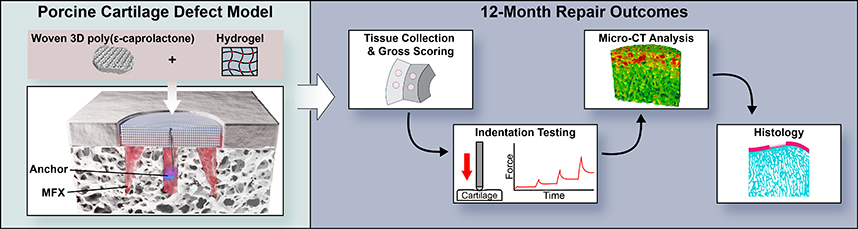
The repair of focal cartilage defects remains one of the foremost issues in the field of orthopaedics. Chondral defects may arise from a variety of joint pathologies and left untreated, will likely progress to osteoarthritis. Current repair techniques, such as microfracture, result in short-term clinical improvements but have poor long-term outcomes. Emerging scaffold-based repair strategies have reported superior outcomes compared to microfracture and motivate the development of new biomaterials for this purpose. In this study, unique composite implants consisting of a base porous reinforcing component (woven poly(ε-caprolactone)) infiltrated with 1 of 2 hydrogels (self-assembling peptide or thermo-gelling hyaluronan) or bone marrow aspirate were evaluated. The objective was to evaluate cartilage repair with composite scaffold treatment compared to the current standard of care (microfracture) in a translationally relevant large animal model, the Yucatan minipig. While many cartilage-repair studies have shown some success in vivo, most are short term and not clinically relevant. Informed by promising 6-week findings, a 12-month study was carried out and those results are presented here. To aid in comparisons across platforms, several structural and functionally relevant outcome measures were performed. Despite positive early findings, the long-term results indicated less than optimal structural and mechanical results with respect to cartilage repair, with all treatment groups performing worse than the standard of care. This study is important in that it brings much needed attention to the importance of performing translationally relevant long-term studies in an appropriate animal model when developing new clinical cartilage repair approaches.
Graphical Abstract
Keywords
- Cartilage defects
- large animal models
- biomaterials
- scaffolds
- long-term outcomes
- cartilage biomechanics
- tissue engineering
- orthopaedics
- articular cartilage repair