
An analysis of predictive factors and potential mechanisms underlying lumbar disc herniation resorption

1 School of Physical Education, Southwest Medical University, 646000 Luzhou, Sichuan, China
2 School of Traditional Chinese and Western Medicine, Southwest Medical University, 646000 Luzhou, Sichuan, China
3 Acupuncture and Rehabilitation Department, The Affiliated Traditional Chinese Medicine Hospital, Southwest Medical University, 646000 Luzhou, Sichuan, China
4 The Faculty of Acupuncture, Moxibustion and Tuina, Sichuan College of Traditional Chinese Medicine, 62100 Mianyang, Sichuan, China
5 Rehabilitation Medicine Department, Hejiang People's Hospital, 646000 Luzhou, Sichuan, China
6 Acupuncture and Rehabilitation Department, Tongjiang Hospital of Traditional Chinese Medicine, 636000 Bazhong, Sichuan, China
§ These authors equally contributed to this paper
Abstract
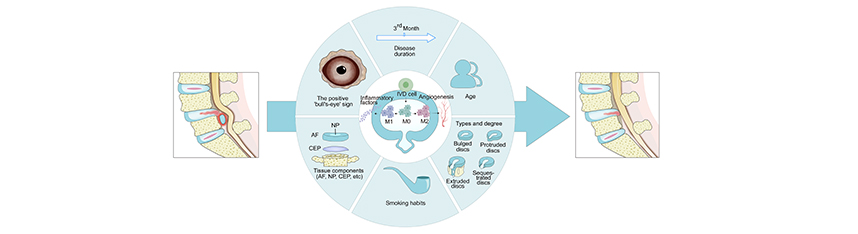
Spontaneous resorption of lumbar disc herniation (RLDH) is a frequently observed phenomenon in imaging studies. However, the predictors of this process are difficult to control, posing a major clinical challenge. Moreover, the underlying biological mechanisms of RLDH remain incompletely understood. This limitation hinders clinicians from optimizing non-surgical treatments of lumbar disc herniation (LDH) in clinical practice. This review summarized the existing literature on the resorption of LDH, aiming to elucidate the predictive factors and potential biomechanical processes underlying this disease. Additionally, existing therapeutic approaches designed to promote resorption were also summarized. By providing insights into the dynamics of LDH resorption, this review offers the possibility of enhancing diagnostic accuracy and facilitating the development of targeted treatment strategies.
Graphical Abstract
Keywords
- Lumbar disc herniation
- resorption
- mechanisms
- predictive factors
- macrophages