
Nisin-enriched coatings on titanium implants preventStaphylococcus aureusbiofilm formation: the Galleria mellonella model as a testing platform
 , G.K. Mannala 1,§, N. Walter 1, D. Mendelsohn 1,3, C. Roupie 4, G. Ladam 4, B. Labat 4, R.M.Y. Wong 5, W.H. Cheung 5, C. Brochhausen 3,6, V. Alt 1, M. Riool 1, P. Thebault 4
1 Department of Trauma Surgery, University Hospital Regensburg, 93053 Regensburg, Bavaria, Germany
2 Department of Trauma, Hand and Reconstructive Surgery, University Hospital Giessen, 35392 Giessen, Hesse, Germany
3 Institute of Pathology, Medical Faculty Mannheim, Heidelberg University, 68167 Mannheim, Baden-Württemberg, Germany
4 Univ Rouen Normandie, INSA Rouen Normandie, CNRS, Normandie Univ, PBS UMR 6270, Rouen, France
5 Department of Orthopaedics and Traumatology, The Chinese University of Hong Kong, 999077 Hong Kong, China
6 Institute of Pathology, University of Regensburg, 93053 Regensburg, Bavaria, Germany
§ These authors equally contributed to this paper
Abstract
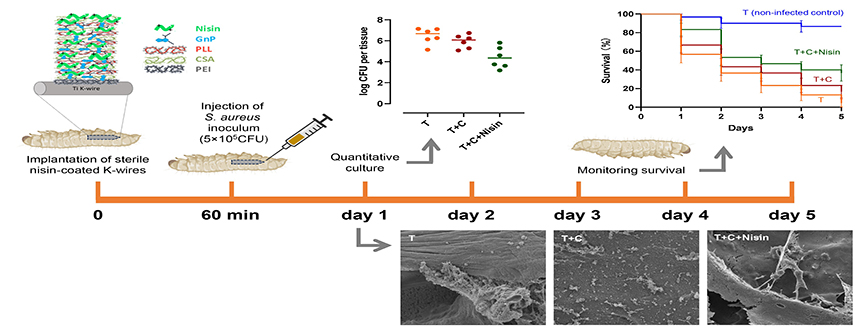
Background:Bone and joint infections pose significant clinical challenges, often leading to severe complications and substantial healthcare costs. Traditional antibiotic therapies are becoming increasingly ineffective due to rising antibiotic resistance and the biofilm-forming ability of bacteria such as Staphylococcus aureus(S. aureus). Antimicrobial coatings offer a promising approach for the prevention and treatment of implant-associated and bone infections. Following the demonstrated in vitro efficacy of nisin, a naturally occurring antimicrobial peptide, in preventingS. aureusbiofilm formation, this study investigates the in vivo potential of a nisin-enriched coating to prevent biofilm-related infections using theGalleria mellonellalarva haematogenous implant infection model.Methods:Methicillin-sensitive S. aureus(MSSA) EDCC 5055 was used to infect larvae implanted with nisin-coated titanium Kirschner wires (K-wires). Survival rates and bacterial loads on both the K-wires and in larval tissue were analysed. Biofilm formation on K-wires was further analysed using scanning electron microscopy.Results:The results showed that nisin-coated K-wires significantly improved larval survival and reduced bacterial burden compared to control groups. Scanning electron microscopy confirmed the absence of biofilm formation on nisin-coated K-wires.Conclusions:These findings suggest that nisin-enriched coatings could be a viable strategy for preventing bone and joint infections. Additionally, this study demonstrates the feasibility of testing implant coatings in a cost-effective and ethically sound alternativein vivomodel. Further evaluation and testing of the nisin-enhanced coating in vertebrate animal implant infection models is warranted.
Graphical Abstract
Keywords
- Nisin
- titanium implant
- Staphylococcus aureus
- Galleria mellonella